When Democracy Gets Double Vision
Election Day 1948 should have been straightforward in Millfield, a sleepy town of 847 residents straddling the border between Ohio and Pennsylvania. Instead, it became the day American democracy experienced its most surreal glitch — a single precinct somehow held two separate, legally valid presidential elections and got two different results.
The chaos that ensued would take six months to untangle and forever change how election officials think about municipal boundaries.
The Perfect Storm of Paperwork
The trouble began months before Election Day with what seemed like routine administrative housekeeping. Millfield had always been a border town, but a recent property survey revealed that the municipal boundaries were more complicated than anyone realized. The town's main street literally straddled the state line, with some buildings technically in Ohio and others in Pennsylvania.
This geographic quirk had never posed a problem until 1948, when both states simultaneously updated their voter registration systems. Due to a comedy of bureaucratic errors, roughly half of Millfield's residents were registered to vote in Ohio, while the other half were registered in Pennsylvania — and nobody realized it until Election Day morning.
Morning Confusion
When poll workers arrived at the Millfield Community Center at 6 AM, they found something unprecedented: two sets of voting equipment, two sets of ballots, and two sets of voter rolls. Ohio election officials had sent one batch, Pennsylvania had sent another, and both states expected Millfield to conduct their respective elections.
"We had Democrats from Ohio, Republicans from Pennsylvania, and a whole lot of confused voters in between," recalled Eleanor Hartwell, who served as chief election judge that day. "Nobody knew what to do."
Phone calls to state election offices only added to the confusion. Ohio insisted that Millfield was conducting an Ohio election. Pennsylvania was equally certain it was a Pennsylvania election. Both were technically correct.
The Solomon Solution
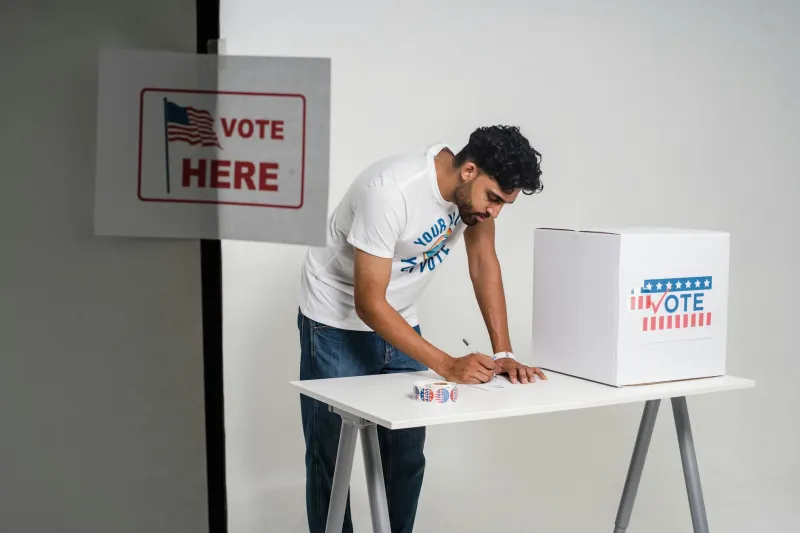
Faced with an impossible situation and a growing line of voters, Hartwell made a decision that would go down in election history. She divided the community center down the middle with a rope and set up two separate polling stations — one for Ohio voters, one for Pennsylvania voters.
"We figured it was better to let people vote twice than not vote at all," Hartwell later explained to investigators.
The problem was determining which voters belonged where. With no clear guidance from either state, poll workers made snap decisions based on which side of Main Street people lived on. East side residents voted in the Ohio election, west side residents voted in Pennsylvania.
The Split Results
When the votes were tallied that evening, the results were as bizarre as the process. The Ohio side of Millfield voted overwhelmingly for Thomas Dewey, while the Pennsylvania side went decisively for Harry Truman. The same town, voting on the same day, had effectively chosen different presidents.
Even stranger, several residents had managed to vote in both elections before poll workers caught on and instituted a hand-stamping system to track who had already voted.
The Legal Nightmare
Word of Millfield's double election quickly reached state capitals, where election officials were baffled. Neither state wanted to invalidate their results, but both recognized that something had gone terribly wrong.
The legal questions were mind-bending: Which election was legitimate? Could residents vote in both states? What happens when the same precinct produces conflicting results for the same race?
Lawyers spent months poring over election law, municipal codes, and interstate commerce regulations. The case eventually reached both state supreme courts, which handed down contradictory rulings — Ohio's court validated the Ohio election, Pennsylvania's court validated the Pennsylvania election.
The Federal Investigation
By spring 1949, federal election monitors had descended on Millfield to investigate what they termed "the most significant election administration failure in modern American history." Their final report, released six months later, revealed the full scope of the bureaucratic breakdown.
The root cause was a perfect storm of coincidences: overlapping municipal boundaries, simultaneous voter roll updates, unclear communication between state election offices, and a local election judge who made reasonable decisions in an unreasonable situation.
The Resolution
Ultimately, federal officials decided that both elections were legally valid within their respective state jurisdictions. Millfield's votes were counted in both Ohio and Pennsylvania's official tallies — making it the only town in American history to participate in two separate presidential elections simultaneously.
The solution going forward was surprisingly simple: Millfield was officially split into two separate municipalities, East Millfield (Ohio) and West Millfield (Pennsylvania), with Main Street serving as the border.
Democracy's Strangest Day
The Millfield incident became a case study in election administration programs across the country. It revealed how easily democratic processes could be derailed by seemingly minor bureaucratic oversights and highlighted the importance of clear municipal boundaries.
Eleanor Hartwell, who became something of a folk hero among election officials, summed it up best: "We always talk about the importance of every vote counting. Well, in 1948, some votes counted twice, and somehow that still felt more democratic than not counting them at all."
Today, sophisticated voter databases and GPS mapping make a repeat of the Millfield incident virtually impossible. But the story serves as a reminder that democracy, for all its noble ideals, sometimes comes down to ordinary people making extraordinary decisions with whatever rope they have on hand.