The Lightning Rod: How One Park Ranger Survived Seven Direct Strikes and Lived to Tell About It
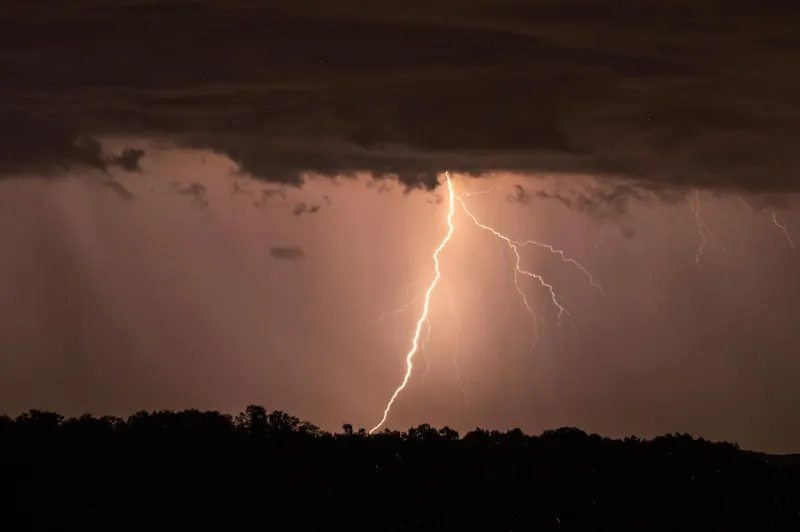
When Lightning Became a Recurring Problem
Imagine being struck by lightning once. The odds alone are roughly 1 in 500,000 in any given year. Now imagine it happening seven times over the course of 35 years. For Roy Sullivan, a quiet park ranger working in the Shenandoah National Park in Virginia, this wasn't a hypothetical—it was his bizarre reality.
Sullivan's first encounter with lightning came in 1942, leaving him unconscious but remarkably alive. The second strike arrived in 1969, nearly three decades later. Then came the truly unbelievable part: between 1969 and 1977, Sullivan was struck five more times. He'd be going about his duties as a ranger, and seemingly out of nowhere, the sky would find him.
The Strikes That Defied Probability
Each encounter left its mark. The 1942 strike singed his leg. In 1969, lightning hit him while he was outside a fire tower, burning his eyebrows clean off. A 1970 incident scorched his shoulder and arm. By 1972, a bolt caught him in his truck, setting his hair on fire—he actually had to stop, get out, and urinate on his own head to extinguish the flames. The image alone seems like something from a dark comedy, yet it's absolutely documented.
The final two strikes came in 1973 and 1977, each one a fresh reminder that Sullivan seemed to exist in some cruel cosmic lottery where he kept winning the worst prize imaginable. Remarkably, he survived all seven encounters, though not without permanent damage. His hearing was compromised. His hair never quite grew back the same way. His body bore the scars of a man who had stared down one of nature's most violent forces—repeatedly—and somehow remained standing.
What makes Sullivan's story even stranger is that he didn't just survive these strikes; he became somewhat famous for it. Guinness World Records officially recognized him as the person struck by lightning more times than anyone else on Earth. He became a minor celebrity, appearing on talk shows and in newspapers. Park visitors would ask to meet the man who couldn't be killed by the sky.
Why Did Lightning Keep Finding Roy Sullivan?
The scientific community found Sullivan's case genuinely puzzling. Lightning doesn't discriminate based on personality or bad luck in any mystical sense, but certain conditions and behaviors do make people more likely to be struck. Sullivan worked outdoors constantly in a mountainous region—already a risk factor. Mountains and elevated terrain attract lightning. His job as a ranger meant he spent hours exposed to the elements during thunderstorms, when most people would be sheltering indoors.
But even accounting for occupational hazard, the probability of seven strikes strains credibility. Some scientists have theorized that Sullivan's body chemistry or the specific electrical properties of his physiology might have made him marginally more attractive to electrical discharge. Others suggest he was simply extraordinarily unlucky, and with millions of people on Earth, someone has to be the statistical outlier.
Electrophysicists have noted that people who survive lightning strikes sometimes show unusual patterns of recovery. Sullivan's body apparently had some remarkable resilience, though each strike still caused measurable harm. His case became a textbook example used in medical and meteorological education—proof that the human body, while fragile, occasionally possesses an almost inexplicable capacity to endure.
The Stranger Truth About Lightning
What's perhaps most remarkable about Sullivan's story is how it reveals the gap between our intuitions about probability and actual reality. We think of lightning as instantly fatal, and for many people, it is. A direct strike from a lightning bolt carries roughly 300 million volts and can heat the air around it to 54,000 degrees Fahrenheit—hotter than the surface of the sun. Yet roughly 90% of lightning strike survivors live to tell their tales, though they often carry lifelong injuries.
Sullivan didn't just survive; he remained functional enough to continue working as a ranger for years after several of his strikes. He drove himself home after some incidents. He got back to work. He lived a relatively normal life punctuated by these extraordinary moments of violence from the sky.
In 1977, after his seventh strike, Sullivan apparently decided he'd tempted fate enough. He largely withdrew from public life, moving away from the mountains that seemed to have some inexplicable attraction to him. He passed away in 1983, reportedly by suicide, though the causes and circumstances remain somewhat unclear in historical records.
The Legacy of an Impossible Life
Today, Roy Sullivan's name appears in lightning strike records and Guinness World Record books as a footnote to human resilience. His story doesn't fit neatly into our understanding of how the world works. Lightning shouldn't strike the same person seven times. The odds shouldn't allow it. Yet they did, and he did, and the universe apparently decided that one Virginia park ranger would become living proof that sometimes reality is far stranger than any fiction we could invent.
When people ask what the most improbable thing that ever happened to someone was, Roy Sullivan's answer sits near the top of the list—a man who couldn't escape the sky, no matter how many times it tried to kill him.